 Global
 Americas
 Deutsch
 Español
 Italiano
 Polski
Testing conducted in accordance with UL 9540A and CSA C800 provides technical evidence to support fire safety assessments for multi-cabinet C&I energy storage installations.
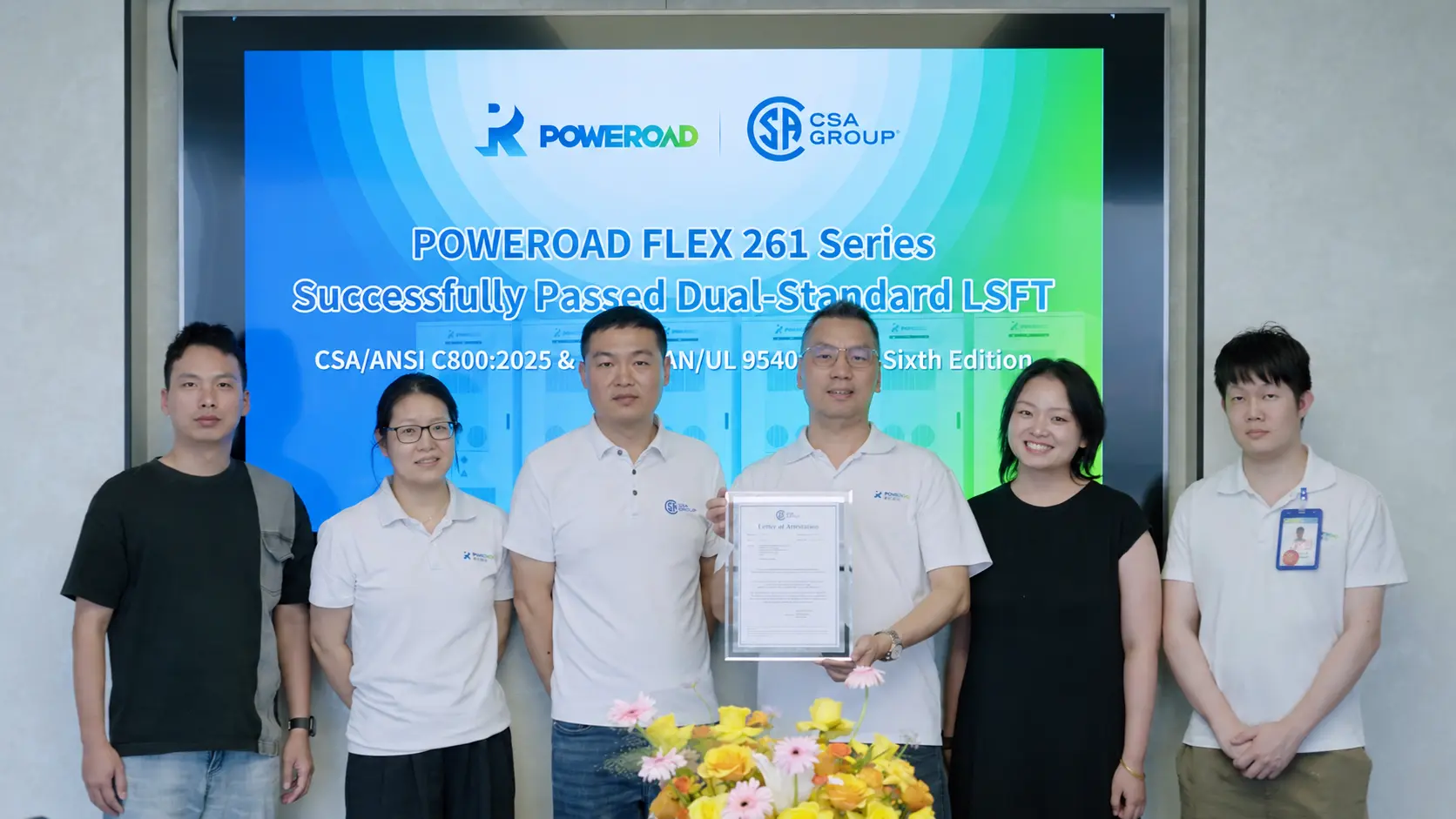
October 22, 2026 — POWEROAD’s FLEX-261 Series has successfully passed large-scale fire testing conducted in accordance with two key fire safety standards: ANSI/CAN/UL 9540A:2026, Sixth Edition, and CSA/ANSI C800:2025. Following the testing, CSA Group presented POWEROAD with a Letter of Attestation documenting the testing and evaluation.
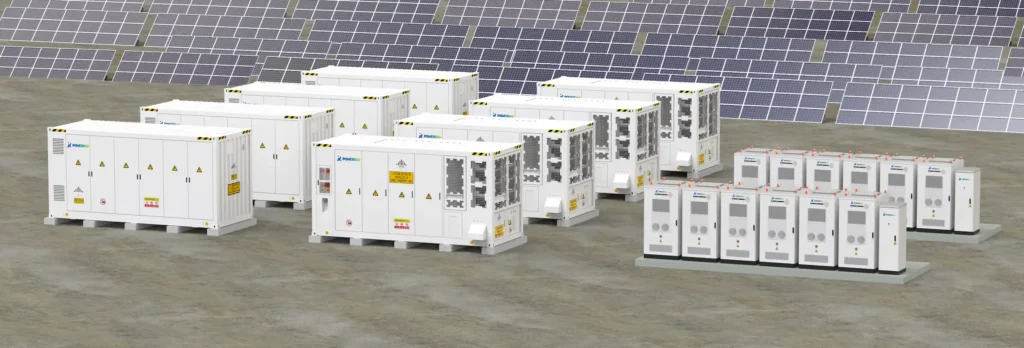
The evaluation covered three models — FLEX 261, FLEX 261 AIO, and FLEX 261 AIO-3S — in multi-cabinet commercial and industrial (C&I) battery energy storage system (BESS) configurations. The results provide technical evidence for system design, fire risk assessment, and compliance planning worldwide.
Dual-Standard Testing for Energy Storage Fire Safety
ANSI/CAN/UL 9540A:2026, Sixth Edition is a globally recognized test method for evaluating thermal runaway and fire propagation in energy storage systems. Section 10 addresses installation-level large-scale fire testing to assess propagation and ignition risks to adjacent units or exposures. It is referenced by NFPA 855 and the International Fire Code (IFC).
CSA/ANSI C800:2025 establishes a framework for large-scale fire testing, including the evaluation of system responses and data from battery management and fire detection systems to support fire risk mitigation and emergency response planning.
These evaluations support the technical assessment of energy storage projects in the US and Canadian markets. Large-scale fire testing (LSFT) data can support fire safety reviews, project permitting, and insurance and financing assessments.
Large-Scale Fire Test: Strong Results Under Challenging Conditions
Conducted in mid-August 2026, the test evaluated fire containment in a multi-cabinet installation under extreme conditions.
The setup comprised five cabinets: one initiating cabinet and four target cabinets. The initiating cabinet was tested at 100% state of charge (SOC), with fire suppression functions disabled and both the cabinet door and deflagration panel manually opened before testing.
The results showed:
- No Fire Propagation:Fire did not spread to the four adjacent target cabinets.
- No Thermal Runaway in Target Cabinets:No cell venting, thermal runaway, or fire was observed in the four adjacent target cabinets.
- Cell Temperatures and Voltages Within Normal Operating Ranges:Measurements in adjacent target cabinets remained within normal operating ranges.
- No Cabinet Collapse:The cabinets maintained their structural integrity during the test.
These results demonstrate the FLEX-261 Series’ fire containment performance and provide technical evidence for fire safety assessments of multi-cabinet C&I BESS installations.
Proven Expertise and Global Project Deployment
POWEROAD’s safety approach encompasses fire safety, data security, and asset protection. The company has established a Joint Energy Storage Safety R&D Center with a national-level fire safety research institute. Its safety framework also includes data security and data management assessments, alongside product liability insurance covering energy storage systems, cells, and lithium battery packs, with coverage of up to USD 5 million.
With more than 1,000 C&I energy storage projects deployed worldwide, POWEROAD continues to apply its safety-focused engineering approach across diverse applications and markets. The FLEX-261 Series test adds further evidence supporting the technical evaluation of its C&I energy storage solutions.
POWEROAD remains focused on delivering energy storage systems engineered for safety, reliability, and long-term performance.
Watch the large-scale fire test video: POWEROAD FLEX-261 Series Large-Scale Fire Test